Ettore Sottsass, Orsete, 1972
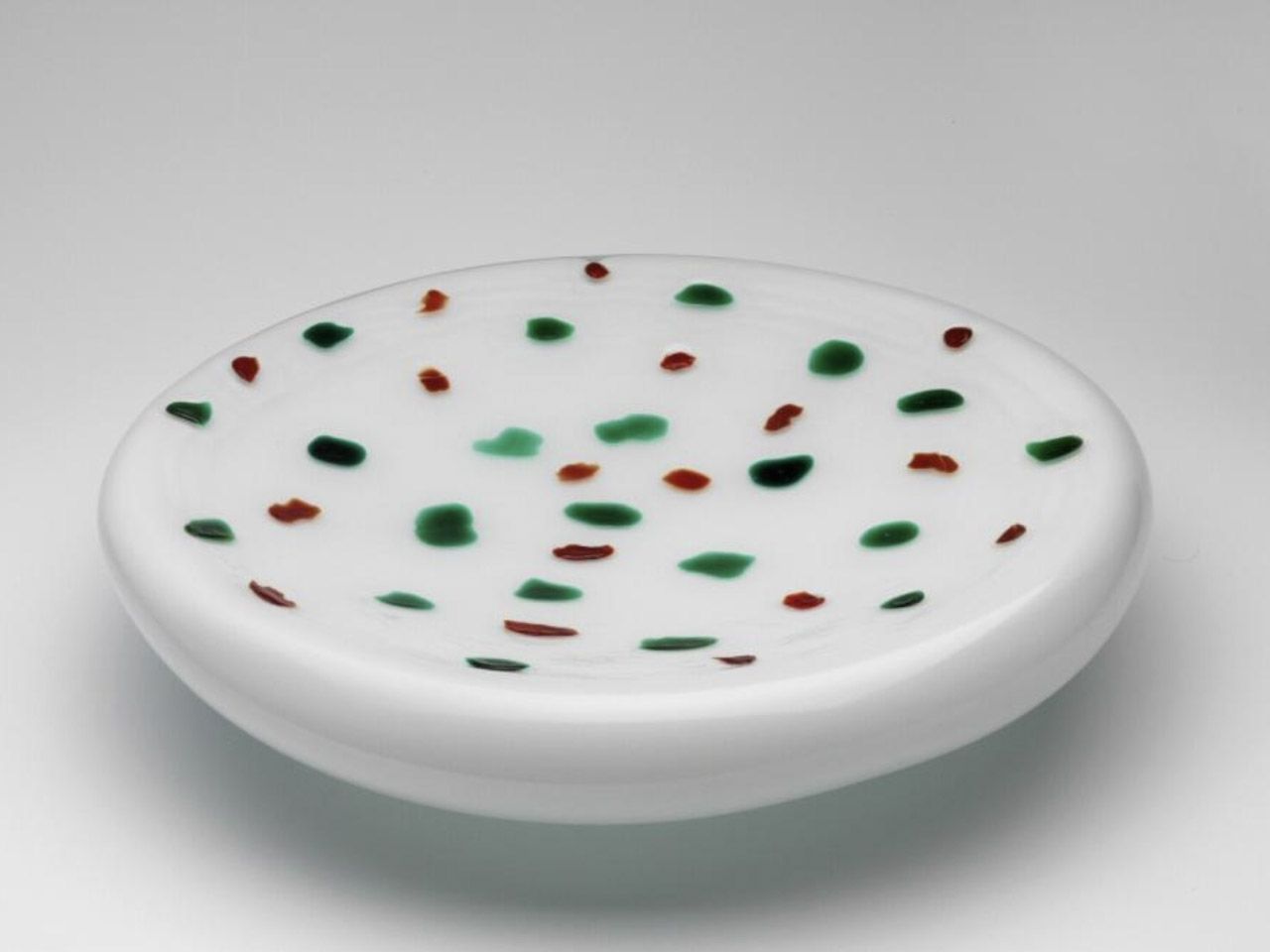
Bowl, 9.8 × 33.6 cm, V2466 (KN&V)
COLLECTION Museum Boijmans Van Beuningen
creation
making process
Material opal glass, white glassTechnique free blownHot working Cap application of coloured glass fragmentsCold working grinding and
polishing
(art) history
Orsete is a line of opal-glass objects featuring bright red and green spots, which Sottsass designed in 1972. It included a bowl, a spheroidal vase and an ovoid vase, both on low circular bases.
Vistosi glassworks in Murano produced this series. In addition to the bowl, there are also two types of
vases in the
Orsete series. Ettore Sottsass always began by making sketches and drawings, which he then had glassmakers bring to life.
Ettore Sottsass was an architect and designer who designed and created a wide range of objects. He studied at the Politecnico di Torino and was a co-founder of the Memphis Group (Michele de Lucchi, George Sowden, Martine Bedin, Peter Shire and Nathalie du Pasquier), a design and architecture collective launched in 1981. The movement was known for its bold colour palette and geometric patterns, which combine playfulness with a light-hearted celebration of fun.
conservation
research & diagnosis
technical analysis
visual examination
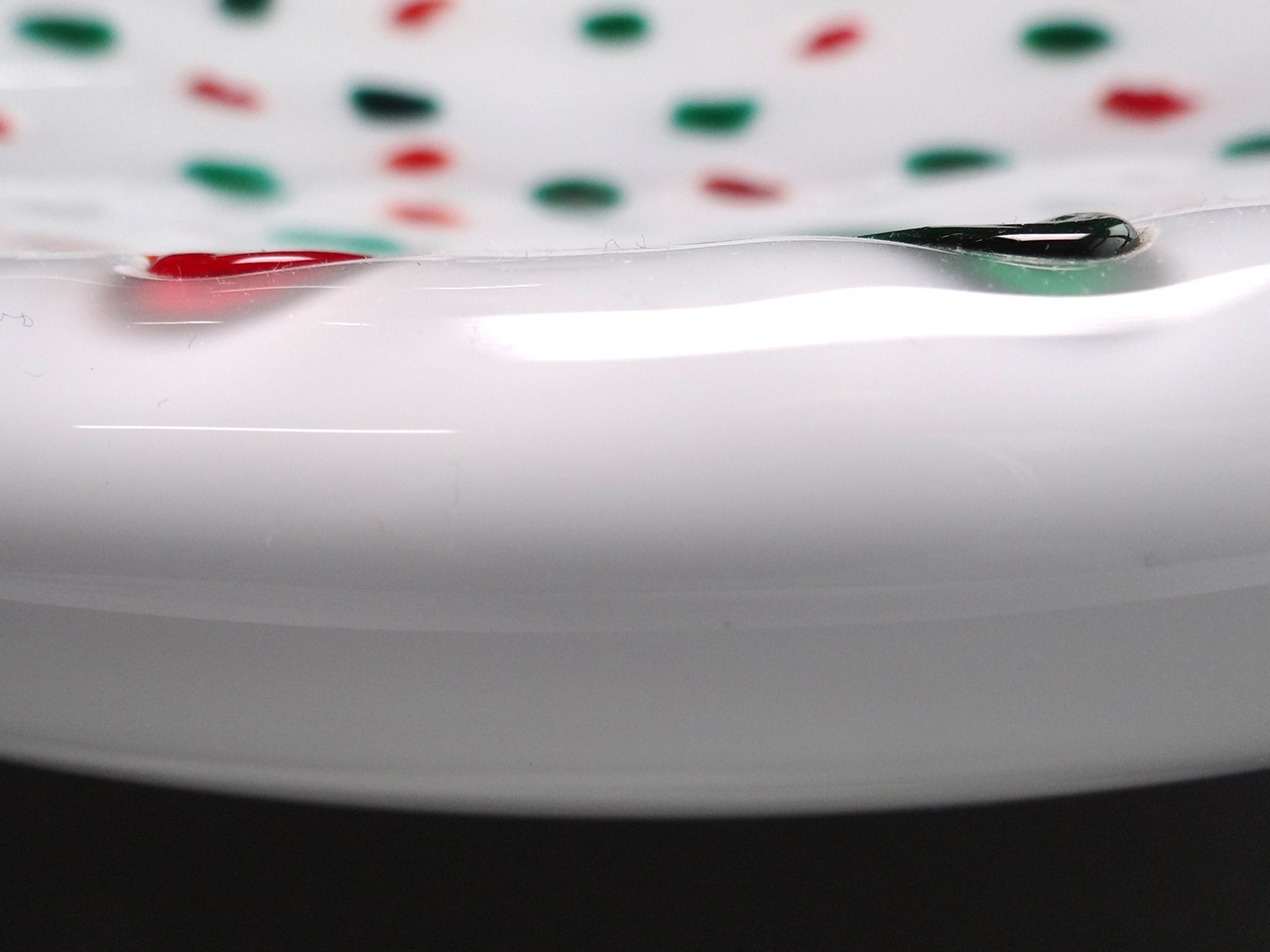
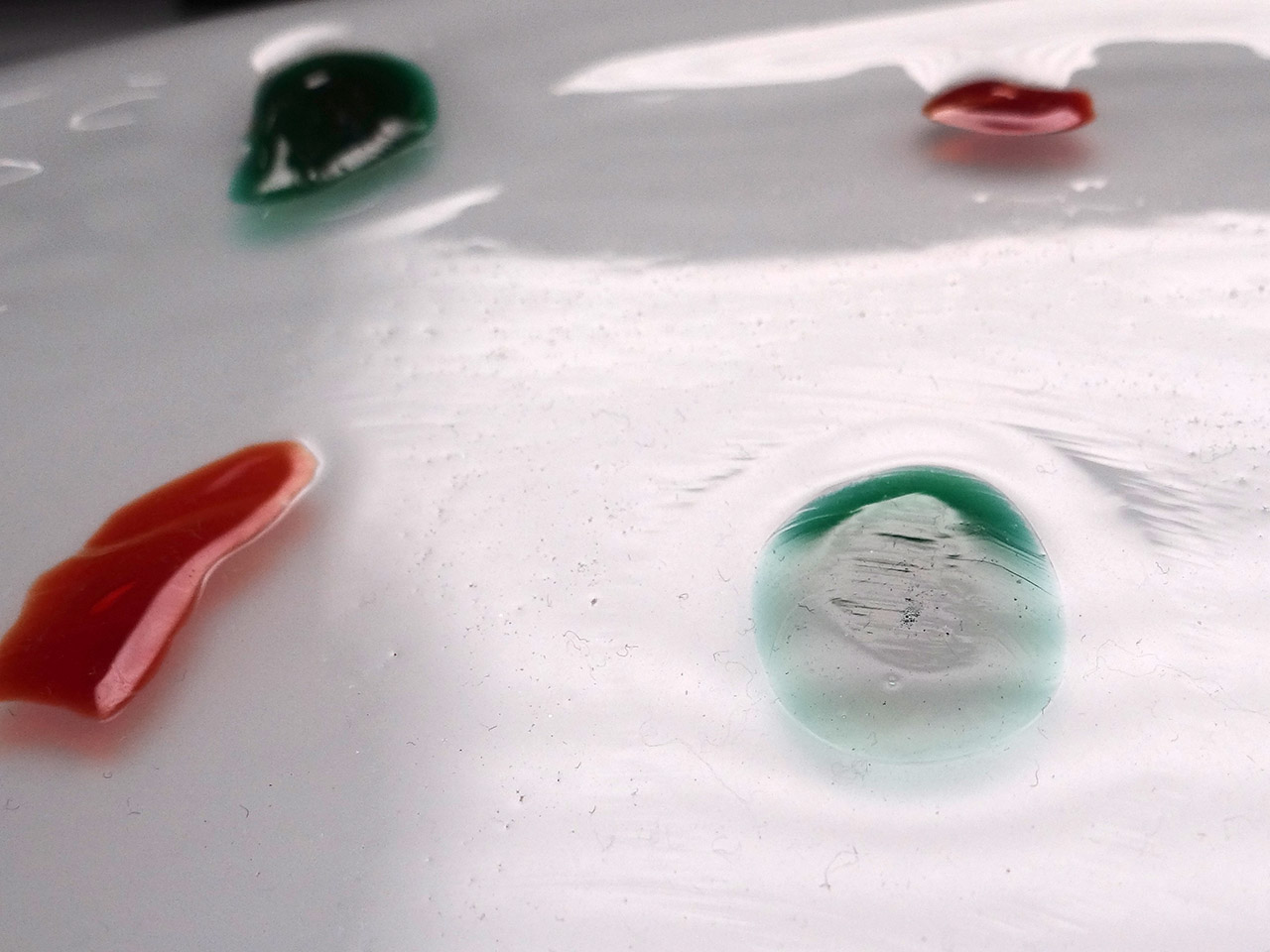
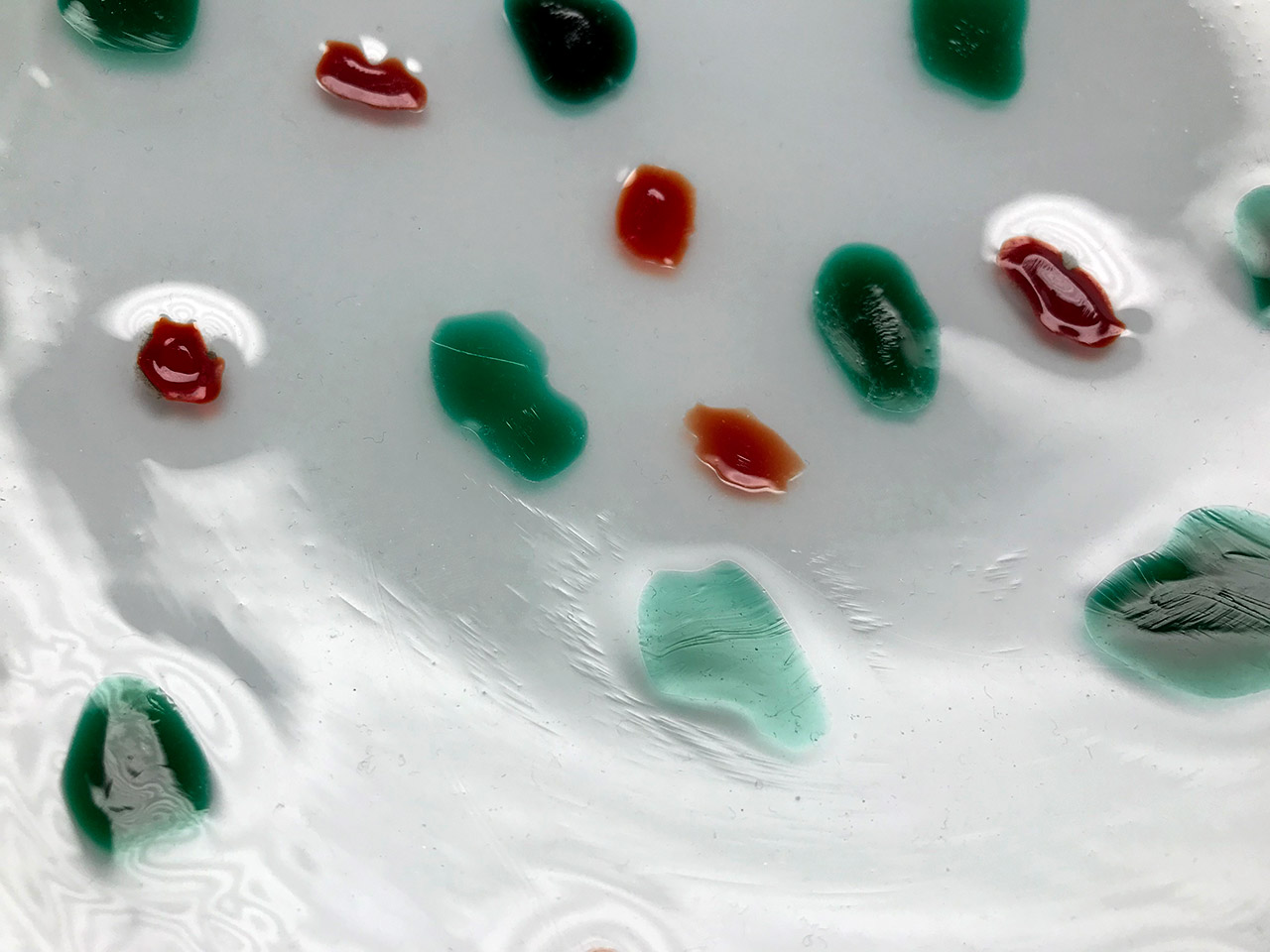
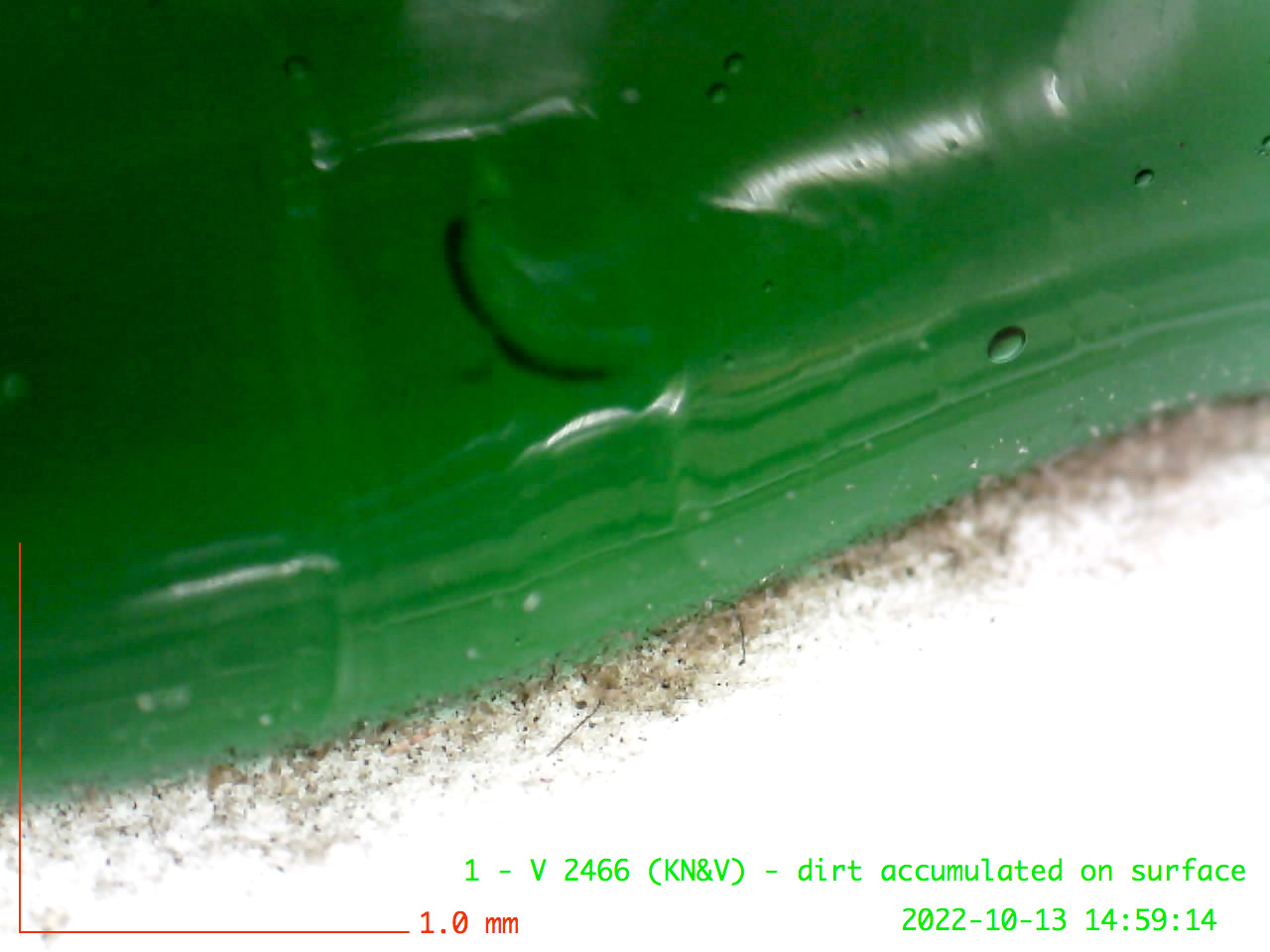
b.1 scratches, b.5 dust, dirt or stain(s), c.1 cloudy appearance, c.2 slippery surface, c.3.2 dust deposits, d.1.1 droplet deposits
The object was visually examined: very slippery inside (bottom) and on the white glass on the top side. The coloured areas of glass are not at all slippery.
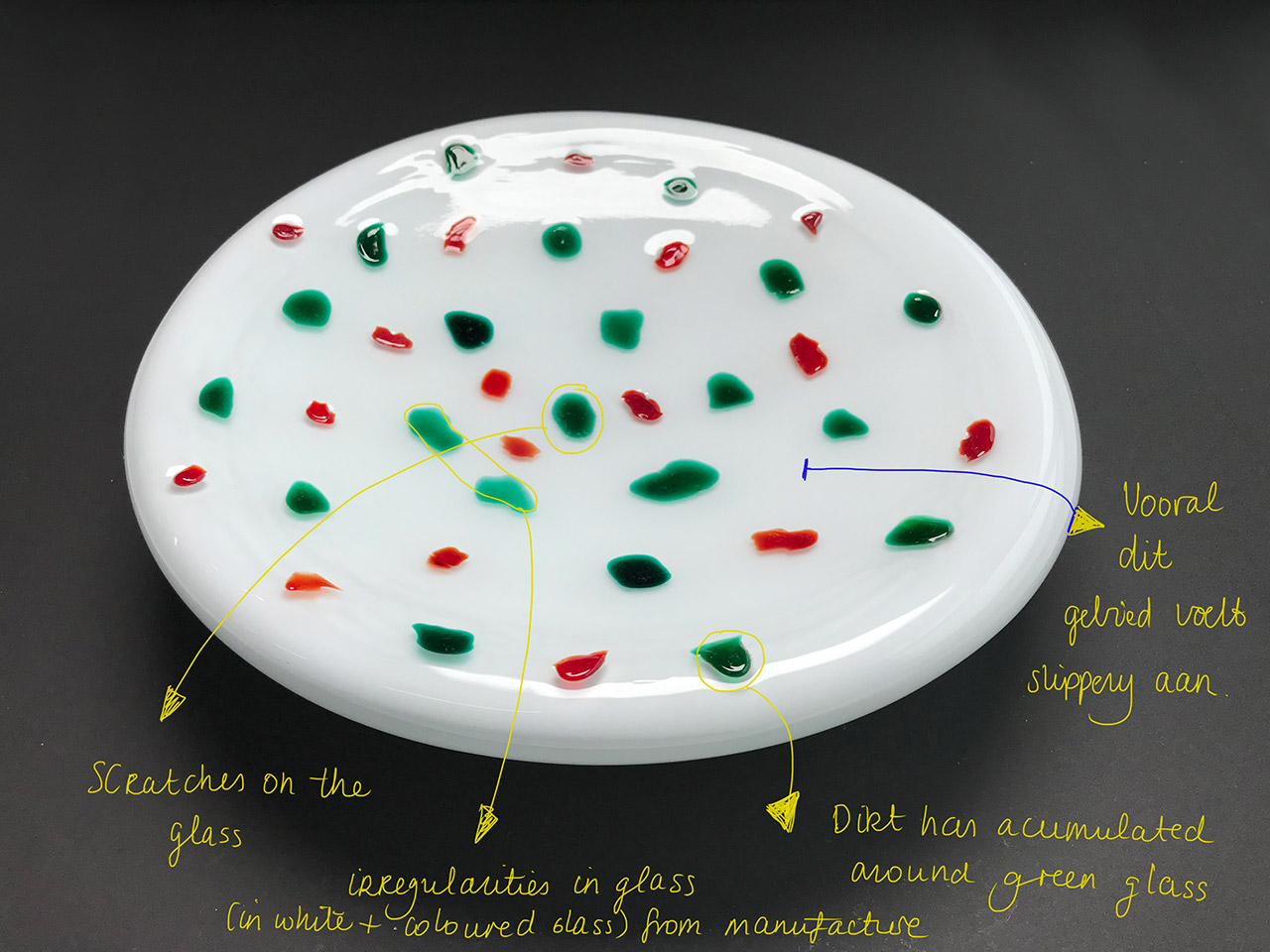 Mapping – positions of findings, top side PHOTO M. Slager
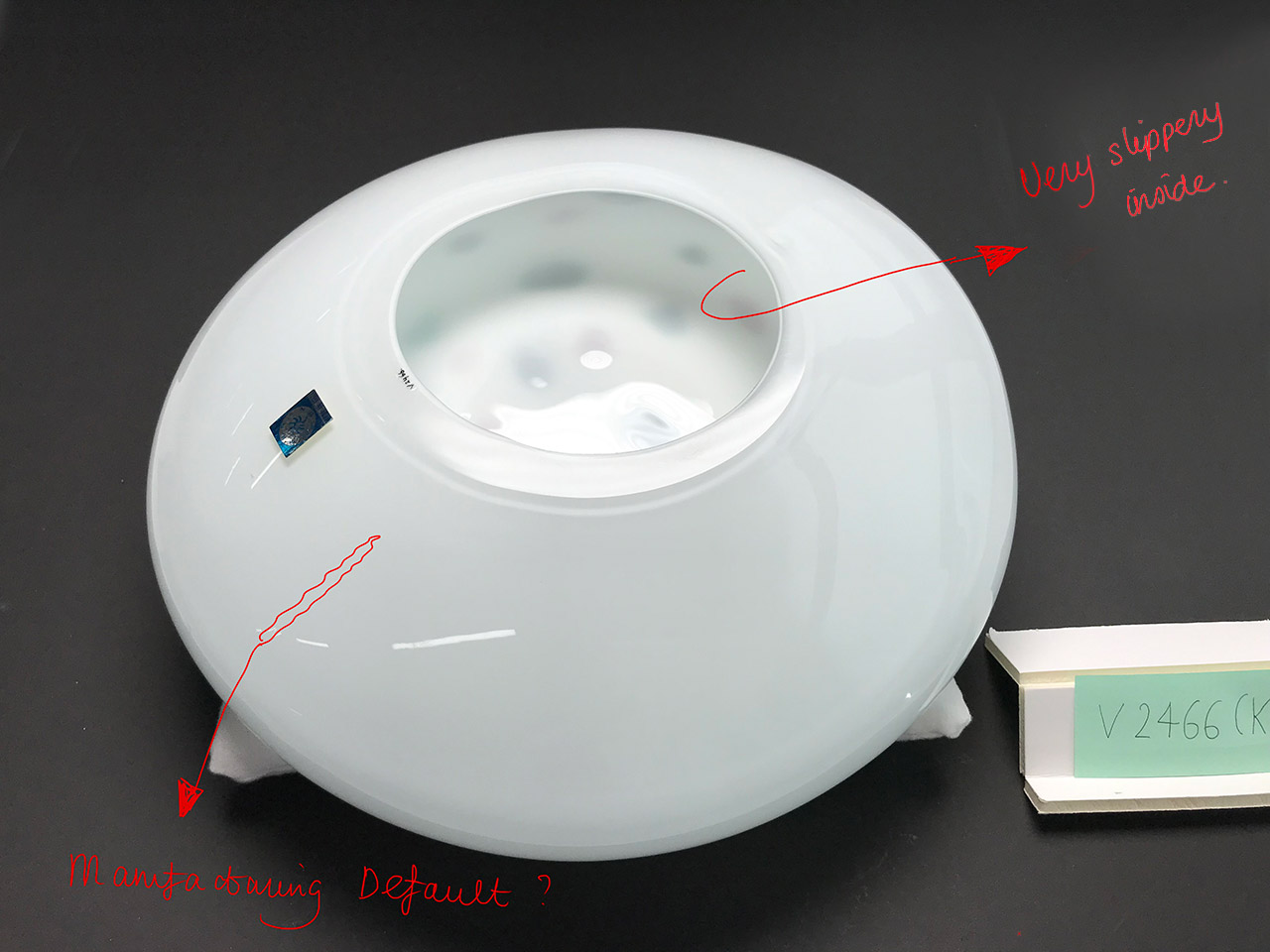 Mapping – positions of findings, underside and interior PHOTO M. Slager
IC analysis of ion concentrations on the surface
The IC analysis shows relatively high concentrations of sodium ions on the surface. Peaks were also observed for chloride and calcium. Concentrations were measured in 2017 and 2020. An increase was observed.
pXRF analysis of the composition
The object was examined during the Cultural Heritage Agency’s ‘Lab op pad’ (Lab on the Road) project in 2021; the results are unknown.
The opal-white glass contains silicon, calcium and sodium as its main elements, and only a small amount of potassium. This indicates soda-lime glass. However, because XRF cannot measure boron and the SiO2 content is very high, the analysis cannot rule out borosilicate glass. Opal glass, however, is not borosilicate glass. It is made by adding a fluoride to the other ingredients. XRF cannot measure fluorine. This glass also contains zinc, arsenic and antimony, which can also cause opacity in glass. Red and green pieces of glass have been fused onto the white glass.
Adding cadmium selenide (cadmium red) to the ingredients gives the glass its red colour. The
red glassalso contains much more zinc than the white and green glass.
Copper and chromium give the
green glass its colour. The amount of arsenic measured is virtually the same in all three colours.
Previous treatments
The object was presumably cleaned in 2013 with a 4:1 mixture of demineralised water and ethanol. Cleaning method unknown.
Condition diagnosis
Condition (visual) very poor
Condition (IC) likely unstable
(Click on photos to enlarge)
advice & treatment
Suggestions for packaging, handling, storage and transport
Advice: record the vulnerabilities of this object in the (museum) documentation system and/or at the relevant location in the (museum) storage facility. Note that it is slippery and must be handled with care.
If you need to touch the object, bear in mind that it is slippery due to ions on the glass surface. Take care when using nitrile gloves! Keep the object in a basket or tray or on a trolley when moving it.
Keep the object in a separate cabinet with other unstable glass. Ensure the object is positioned so that its condition can be easily monitored and that it is readily accessible for inspection.
Suggestions for monitoring the environment and climate
Keep the object in a stable environment with minimal fluctuations in humidity and temperature. It is highly advisable to monitor both the condition of the object and the climatic conditions regularly to detect changes at an early stage and to analyse any links with the environmental conditions.
Suggestions for treatment
Research indicates that the condition of the object is deteriorating. The concentration of ions on the glass surface has begun to rise again following a previous cleaning treatment. This deterioration is currently being investigated to devise specific cleaning strategies. Cleaning the object is advisable because droplets on the surface contribute to further degradation.
Only a glass conservator can determine whether cleaning is desirable and feasible, which cleaning method to use and how to closely monitor the condition. If undertaken, only a glass conservator should clean the glass.
Suggestions for further research
Further research into glass instability, particularly in relation to cleaning, and into the storage of unstable glass is urgently needed.
×
Slippery surface, dust clings easily, irregularities in the glass
Slippery surface, dust clings easily, irregularities in the glass
Slippery surface, dust clings easily, irregularities in the glass
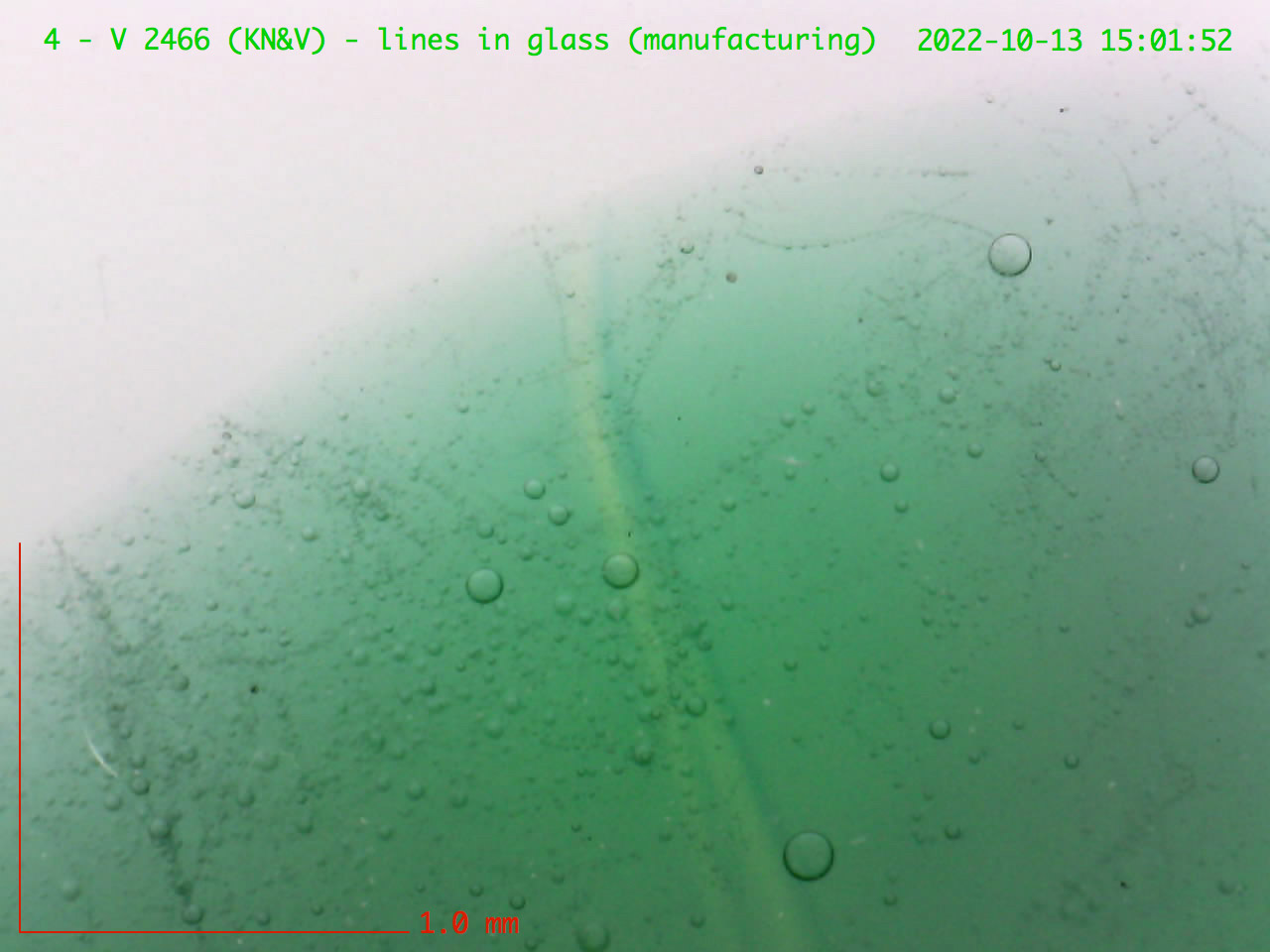
Micrographs PHOTO M. Slager, 2022
Micrographs PHOTO M. Slager, 2022