Ettore Sottsass
Ettore Sottsass (1917–2007) is best known as the founder of the Memphis Group design collective that emerged in the 1980s. Although trained as an architect, he was also a painter, and the bright colours and geometric forms of movements such as Art Deco and Pop Art were major sources of inspiration. After the Second World War, he opened his design studio, specialising in industrial design. His work for Olivetti helped transform office products, making them more colourful and informal. He co-founded the Memphis Group in 1981, bringing together designers who gave everyday objects – furniture, lamps, glassware, ceramics – a postmodern character. The group remained active until 1987, after which Sottsass continued to design independently and for manufacturers such as Alessi.
Quote: ‘I have never actually made glass with my own hands, I have never blown into the long blowing iron to make a piece of glass, and I don’t think I would even be capable of picking a gob of burning glass out of the lake of red-hot glass at the bottom of the “boa del forno”… I know absolutely nothing about these risks and pleasures, and I certainly never will know anything about these secret pockets of knowledge. It only remains for me to stand and watch the people who do possess that knowledge.’
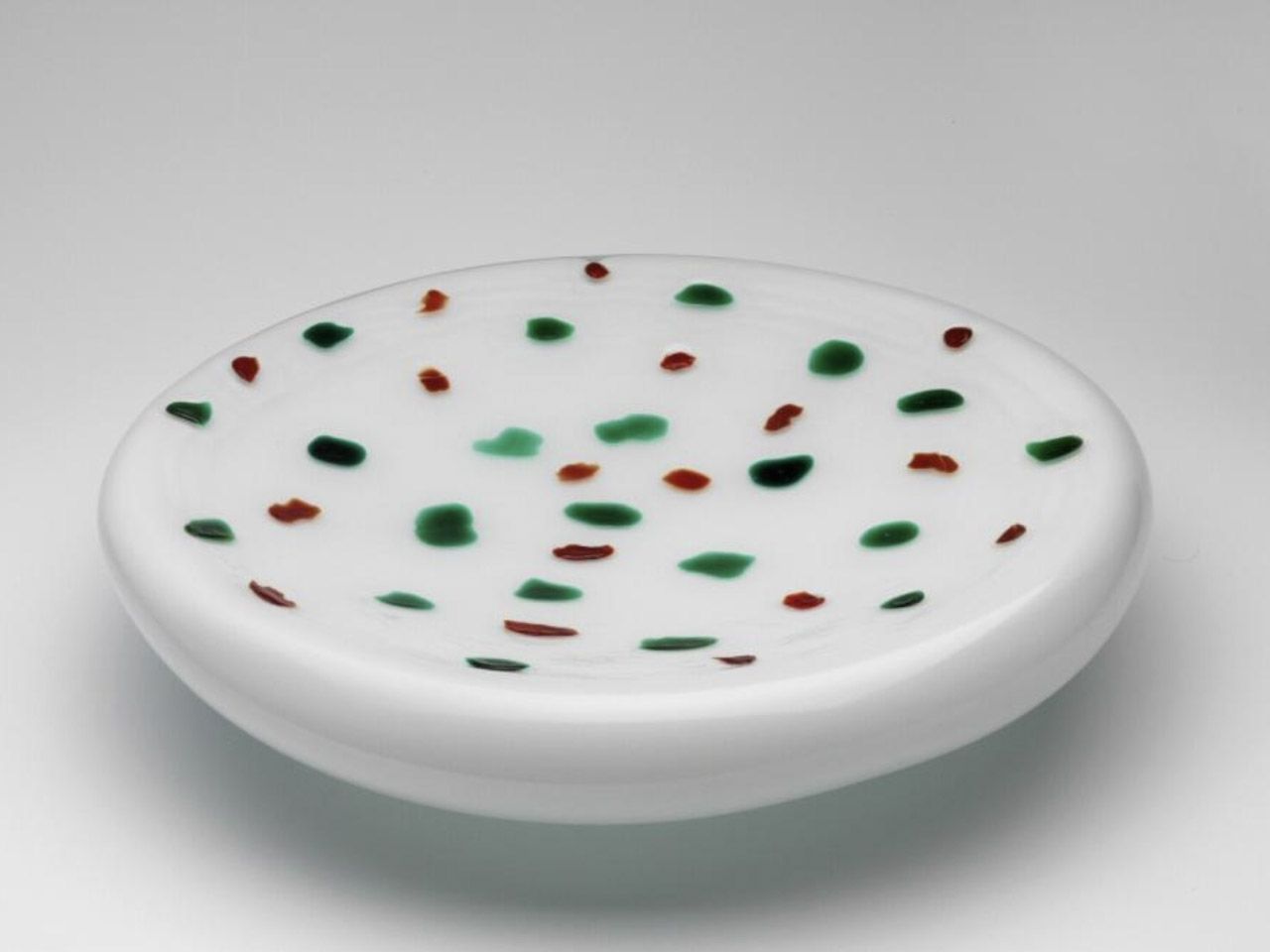
Orsete iis a range of opal glass objects with bright red and green dots. Designed by Sottsass in 1972, the series was produced at the Vistosi glassworks in Murano and included at least a bowl and two types of spherical footed vase.
This work,
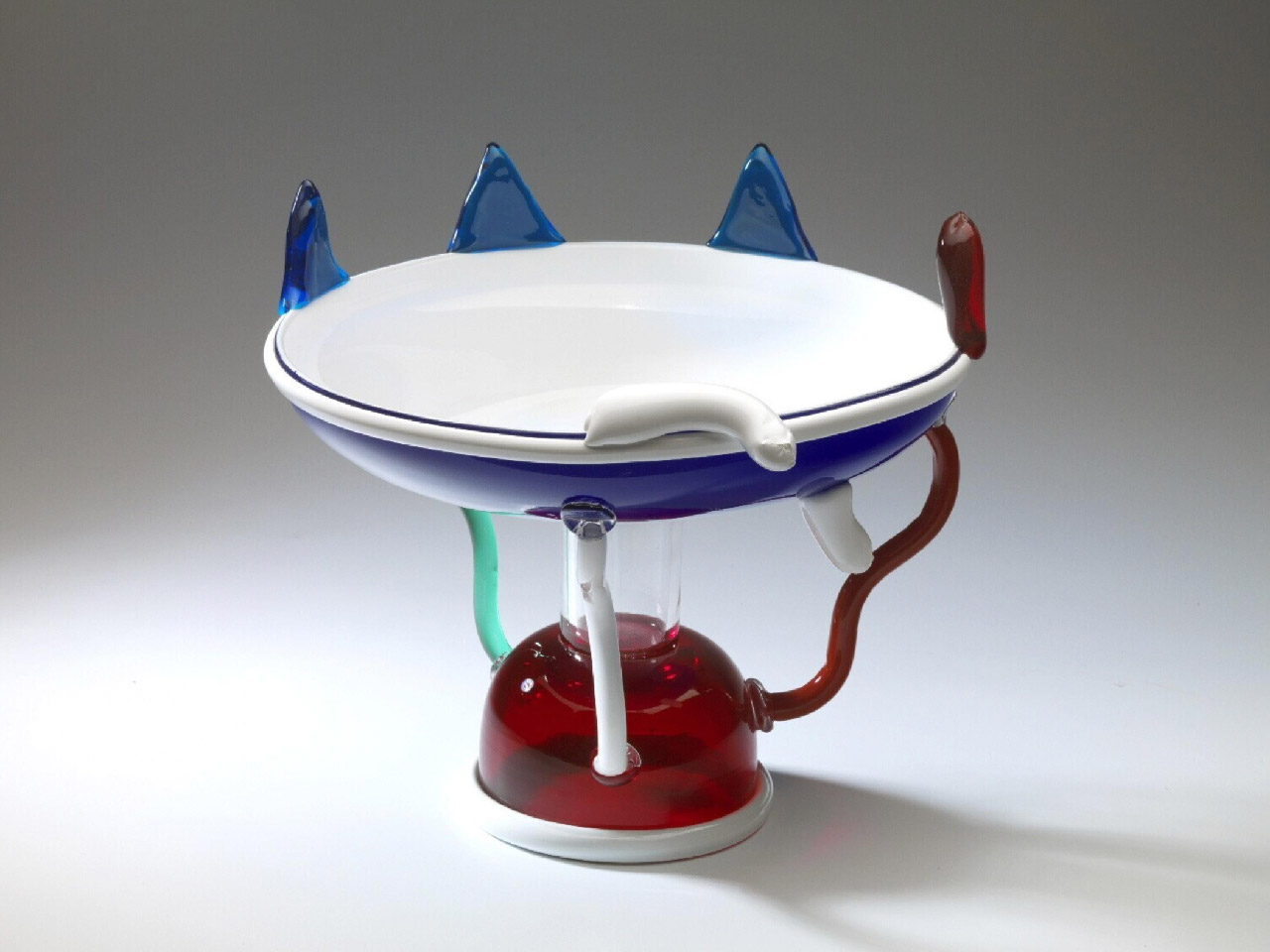
Sol, was produced at the Toso Vetri d’Arte glassworks and is held in the collections of the Stedelijk Museum Amsterdam and the
Musée des Arts Décoratifs. The latter notes that Sottsass did not use traditional Murano glassmaking methods but instead employed a cold-bonding technique, presumably to join the different components.
An examination of the
Sol in the Museum Boijmans Van Beuningen collection shows that all components are made of glass and were joined using hot-working techniques. This is particularly remarkable given that the components are made from different types of glass (see also the XRF documentation for
Sol) and demonstrates the technical expertise of Murano glassmakers in producing objects of this kind.