creation
(art) history
Preliminary note: The pages and texts in this section are not exhaustive. This section only covers topics relevant to
objects in the Museum Boijmans Van Beuningen guide collection. For more detailed information, consult this website’s references, the
Corning Museum of Glass,
Nationaal Glasmuseum,
sources page, Wikipedia and other sources.
Why ‘(art) history’ and not history or art history?
a. Because it leaves room for other types of glass objects, such as flat glass and scientific instruments.
b. Because historical also refers to the specific history of an object (its object biography).
For each guide object, art-historical information relevant to the conservation diagnosis has been selected, supplemented where applicable by provenance, past environmental conditions (archaeological finds) or other historical contexts of use.
The discovery of colourless transparent glass
Glass is made from sand, soda and lime. These natural raw materials also introduce impurities into the glass. Iron, for example, gives glass a yellowish or greenish tint, as seen in the green römers of the Middle Ages or blue-green glass of the Roman period.
By the end of the 12th century, glassmakers had gathered in the Italian city of Venice and across the Venetian lagoon, sharing formulas, developing new techniques and establishing a glassblowers’ guild. From the end of the 13th century, they were permitted to work only on the island of Murano to prevent Venice, built on wooden piles, from burning down in the event of a glass furnace accident.
The glassblowers of Murano sought to make glass as colourless and transparent as possible, aiming to replicate the precious, clear rock crystal from which magnificent chandeliers and table pieces were made. Around the 15th century they succeeded, producing a transparent, colourless glass they named
cristallo in reference to rock crystal.
Venetian glass was enormously popular, and the city guarded its formulas jealously. Foreign glassblowers were unwelcome, and Venetian glassblowers who left risked punishment. Nevertheless, glassmakers elsewhere attempted to replicate it, producing what became known as
à la façon de Venise, French for ‘in the manner of the Venetian style’.
The discovery of lead glass
George Ravenscroft is credited with the discovery of lead glass in the late 17th century, when he succeeded in producing a beautifully clear, colourless glass by adding lead oxide. The glass was easier to work and well suited to cutting. Today strict regulations govern lead glass classifications. In the EU ‘full lead crystal’ must contain at least 30% lead, ‘lead crystal’ at least 24% and ‘crystal glass’ at least 2.45%. The US has different regulations.
The Studio Glass Movement
The term ‘studio glass’ originated in the United States and refers to glass made as art by glassmakers in their studio. Until the late 1950s, glass artworks were generally designed by artists and executed by glassmakers. Glass was not yet established as an artistic medium in its own right. In the late 1920s, Andries Copier was one of the first in the Netherlands to design glass works with greater artistic freedom, although he still worked in recognisable forms such as vases. He also helped establish the ‘Leerdam Unica’ line of unique artistic glass objects produced by Leerdam Glass Factory. These objects initially grew out of experiments he carried out with master glassblower Gerrit Vroegh (1874–1940) to explore the possibilities of glass. As in Scandinavia and elsewhere at the time, the factory invited artists and designers to carry out such experiments with master glassblowers and technicians on product development and the creation of Unica objects.
Harvey K. Littleton, an American who originally trained as a ceramics instructor, travelled to Venice in 1957 to study glassmaking techniques. Back in the US, he remained fascinated by the material and was eager to explore its possibilities on location. At a symposium in 1962, he met Dominique Labino, head researcher at a fibreglass manufacturer, who helped him build a small melting furnace, burners and an annealing oven. Littleton could now make his own glass in an artistic manner. Artists could get a feel for the material and realise ideas directly – a revelation that greatly enhanced creativity. Marvin Lipofsky and Samuel J. Herman were among the first of Littleton’s students to pursue their own practice in glass.
During the World Crafts Council’s 1964 international conference in New York, Littleton demonstrated free-form glassmaking outside the conference centre using his portable gas kiln. Glass designers from all over the world watched his demonstrations with great enthusiasm, many picking up a blowpipe for the first time. It was here that Willem Heesen and Sybren Valkema met Littleton and were inspired by his working methods. Valkema brought this knowledge back to the Netherlands and founded the glass department at the Gerrit Rietveld Academy in 1965. By 1969, it was fully operational as the first department of its kind in Europe. The academy became central to the development of post-war European studio glass, and many prominent artists trained there.
Modern glass technology
Otto Schott played an important role in the development of modern glass technology. Together with Carl Zeiss and Ernst Abbe, he founded the Glastechnisches Laboratorium Schott und Genossen, which later became the
Jenaer Glaswerk Schott & Gen. Known today as Schott AG, the company is still based in Jena, Germany.
Roni Horn has produced work in collaboration with Schott.
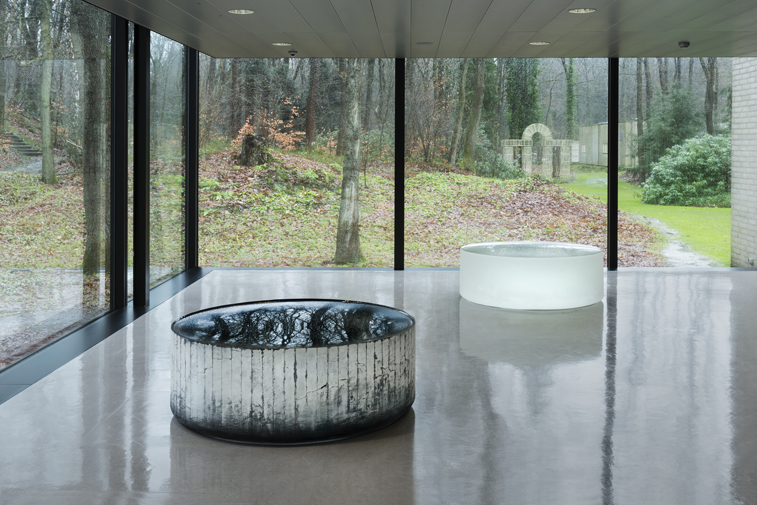 Roni Horn, Opposites of White, 2006-2007 COLLECTION Kröller-Müller Museum
Glass fibres have found applications in a wide range of fields. In 1966 Charles Kao published an article on the potential of using optical fibre as a means of communication, for which he was awarded the 2009 Nobel Prize in Physics. His theoretical work inspired researchers at Corning Inc., who produced the first low-loss fibre-optic cable. Artist Yvette Kaiser Smith incorporates glass fibre into her crocheted works.
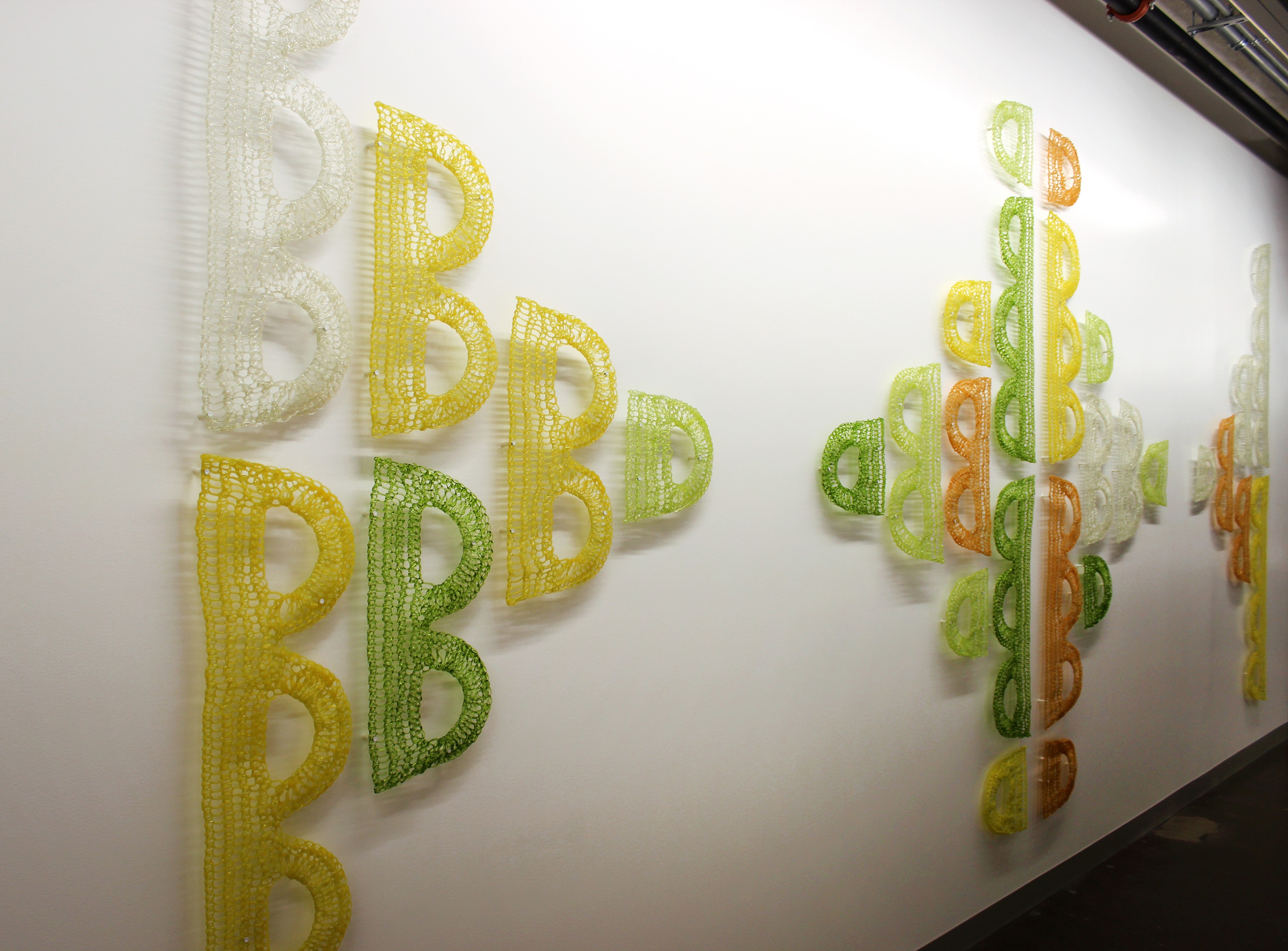 Yvette Kaiser Smith, Pascal’s Bridges, 2018, Crocheted fiberglass with polyester resin, nylon spacers
New developments in glass technology sometimes influence artists. Raphael Hefti was inspired by the Luxar coating process for producing museum glass. His work uses glass sheets upon which colour effects are created by metal vapours that adhere to the glass surface under an electric current in a vacuum.
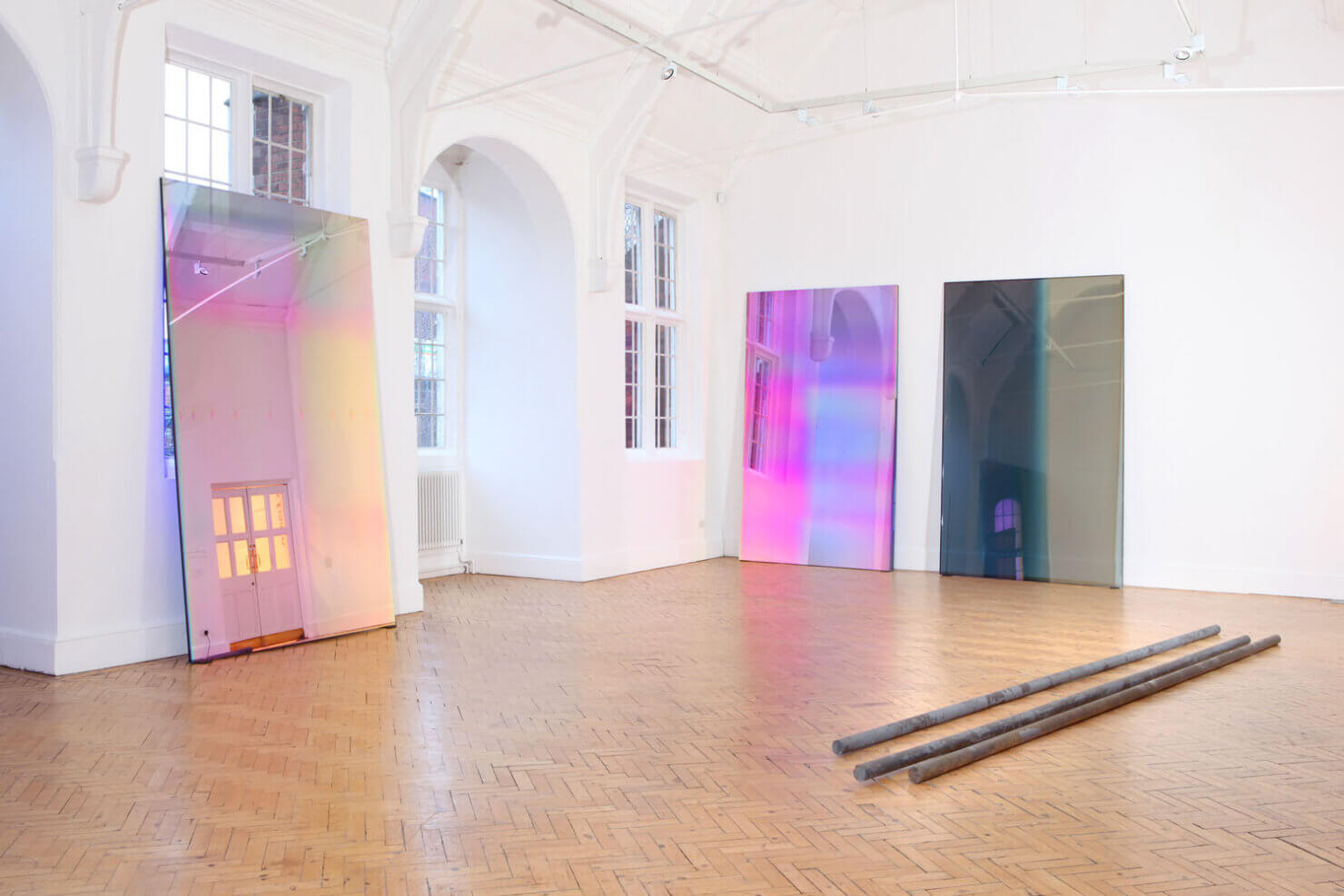 Raphael Hefti, Launching Rockets Never Gets Old, 2012, Installation view at Camden Arts Centre ©Raphael Hefti