conservation
research & diagnosis
vulnerabilities in glass
atmospheric degradation
Glass is not an inert material. Moisture in the air can trigger certain irreversible degradation processes. Though some still use the term ‘glass disease’, conservators prefer ‘chemical instability’, as this degradation process stems from an imbalanced glass composition. The problem occurs in many collections. Research at Museum Boijmans Van Beuningen revealed that approximately 17% of the glass collection is unstable. Even higher percentages are cited in some other collections.
the three factors influencing atmospheric degradation
1 — The physico-chemical properties of glassAt the molecular level, glass has a disordered, amorphous structure. This allows molecules on the surface to change, penetrate or migrate. (see
what is glass?)
2 — The formula or ingredients: an unstable compositionIf the glass contains too few stabilisers (less than 8% lime (calcium)) or the proportion of fluxing agents (sodium or potassium) is too high, the balance between ingredients becomes unstable, making the glass susceptible to atmospheric degradation. (see
what is glass?)
In the following illustration, the area of instability is shown in red.
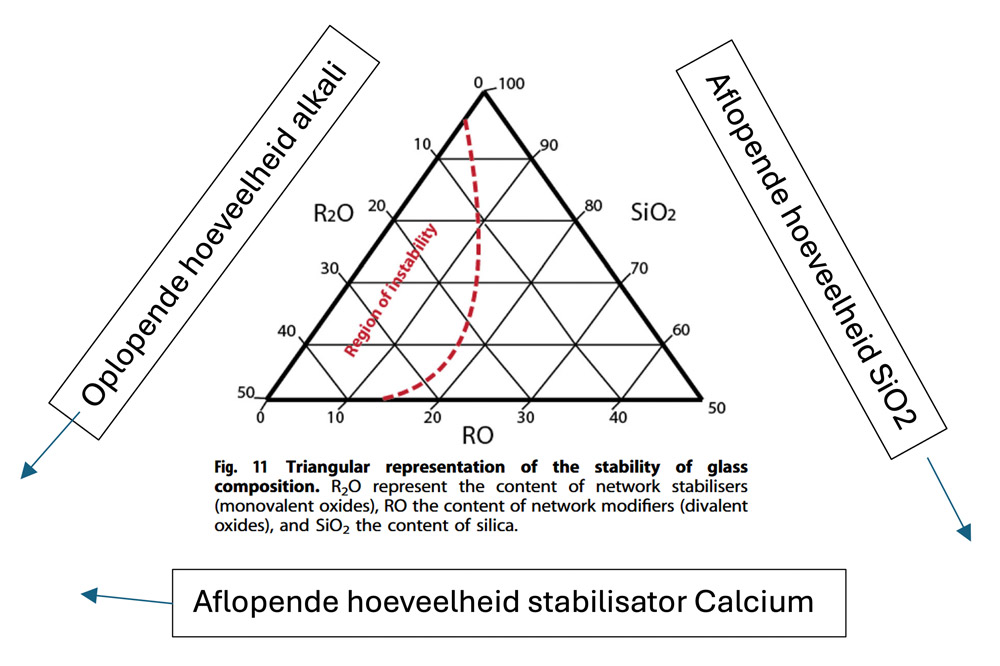 Representation based on pure starting materials. CHART Newton, R. ‘The Weathering of Medieval Window Glass’, Journal of Glass Studies. 17 (1975): 161–168
Oplopende hoeveelheid alkali = Increasing alkali content
Aflopende hoeveelheid SiO2 = Decreasing SiO2 content
Aflopende hoeveelheid stabilisator Calcium = Decreasing calcium stabiliser content3 — Environmental factorsMoisture in the air can attack the surface of the glass. Other environmental factors, such as formaldehyde vapours from certain types of wood-based panel products, can also affect the degradation process. (see
storing unstable glass)
what happens?
When water molecules in the air come into contact with a glass surface, the network at the surface can undergo hydrolysis. Hydronium ions penetrate the glass. The bonds between the silica tetrahedra can be broken. Furthermore, alkali ions at the outermost regions of the glass surface can be dissolved and migrate from the glass to the surface. Acidity plays a role in the process of hydrolysis and ion migration. The result of these processes is the formation of a gel layer, with physico-chemical properties that differ to those of the core of the glass. This layer has many names in the scientific literature: altered layer, hydrated surface layer, alkali-deficient layer, silica-rich layer, hydrogen glass, leached layer, gel layer, hydrated glass, altered surface layer.
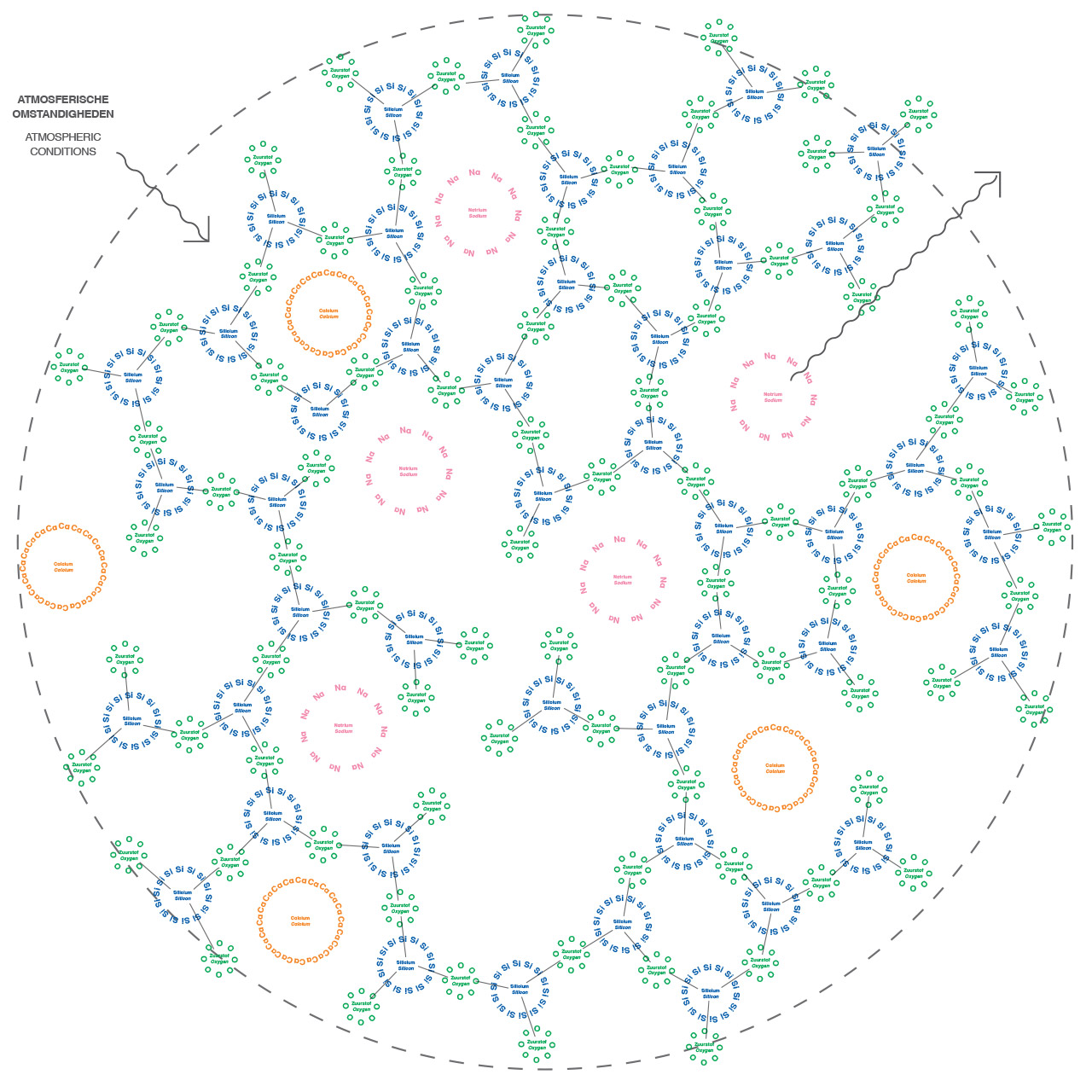 Schematic illustration of the atmospheric degradation process. DESIGN Koehorst in ‘t Veld. Commissioned by Museum Boijmans Van Beuningen for the exhibition Weeping Glass, 2025.
The alkali ions at the glass surface can form compounds with substances in the air, resulting in various salts appearing as droplets or crystals on the glass surface. The concentration of these salts, composed of ions, can be measured. (see
IC analysis). This provides an indication of chemical instability and assists in diagnosing atmospheric degradation.
Various salts, such as formates, can form on the glass. These result from the reaction of potassium or sodium with substances in the environment, such as formaldehyde. Such salts can appear on the glass surface as crystals or as an aqueous solution, depending on the relative humidity and the crystallisation or deliquescence points (the humidity at which a dissolved salt crystallises and at which a crystallised salt absorbs moisture from the atmosphere and begins to form an aqueous solution). The factors that influence and determine the crystallisation and deliquescence points of salts are highly complex. Broadly speaking, one could say that potassium formate dissolves at a relative humidity of 19% (see
DRH (Deliquescence Relative Humidity) – preventive treatment) and is therefore highly susceptible to droplet formation on the glass. Sodium formate dissolves at 56%. Therefore, in a museum environment where the relative humidity fluctuates around 56%, sodium formates can appear as droplets or crystals on the glass surface.
Hydration of the glass surface might alternate with periods of dehydration. The stress this generates can cause cracks to form in the glass.
Measuring ions using ion chromatography
Ion concentrations can be measured as an indicator of chemical stability. Cations and anions can be determined using ion chromatography. (see
IC analysis)
sources / further reading
Biron, I. et al.,
Glass Atmospheric Alteration, Cultural heritage, industrial and nuclear glass, Hermann, Parijs, 2019
Burghout, F. en Slager M.,
Cloudy Patches and Misty Glass: Early Signs of Glass Disease? In: Roemich H. and K. van Lookeren Campagne (eds.) Recent Advances in Glass, Stained-Glass and Ceramics Conservation, Amsterdam, the Netherlands, 7-10 October 2013, pp. 327-329
Kobb K.C.,
Through the Smithsonian Glass and What Alice Found There: Development of a Pan-Institutional Survey of Glass Collections at the Smithsonian InstitutionKoob, S. P.,
Conservation and Care of Glass Objects, 2006
Newton, R., Davison, S.,
Conservation of Glass, Butterworth-Heinemann Series in Conservation and Museology, 2003, blz. 135-164
Verhaar, G. et al.,
Investigating Ion Depletion in Unstable Historic Glass Samples Using Laser Ablation-Inductively Coupled Plasma-Mass Spectrometry and Ion Chromatography, in Recent Advances in Glass and Ceramics Conservation, Interim meeting ICOM-CC working group, London, 219, blz. 45-54
instabiel glas
Glassblower Marc Barreda taking part in the ‘Unstable Glass’ research project. If the stabiliser is removed from the formula, the result is a highly unstable glass composition: a sodium silicate that is particularly sensitive to moisture and will degrade rapidly when exposed to it for a prolonged period. The video explains how various glass formulas are used to produce unstable glass. ©Museum Boijmans Van Beuningen
Glass Disease, a video created for the exhibition ‘Weeping Glass’ at Museum Boijmans Van Beuningen ©Museum Boijmans Van Beuningen
links
Research collection glass, Museum Boijmans Van Beuningen
Exhibition ‘Weeping Glass’, Museum Boijmans Van Beuningen