conservation
research & diagnosis
vulnerabilities in glass
atmospheric degradation
Ion Chromatography (IC) Analysis
Glass instability is difficult to diagnose visually at an early stage. Ion Chromatography (IC) is a method that makes this possible. This analytical method enables measurement of the concentration of salts deposited on a glass surface as a result of atmospheric degradation. It can also be used to identify the various anions and cations. A conservator can carry out the sampling and request the analysis. IC analysis can be carried out by the Cultural Heritage Agency of the Netherlands.
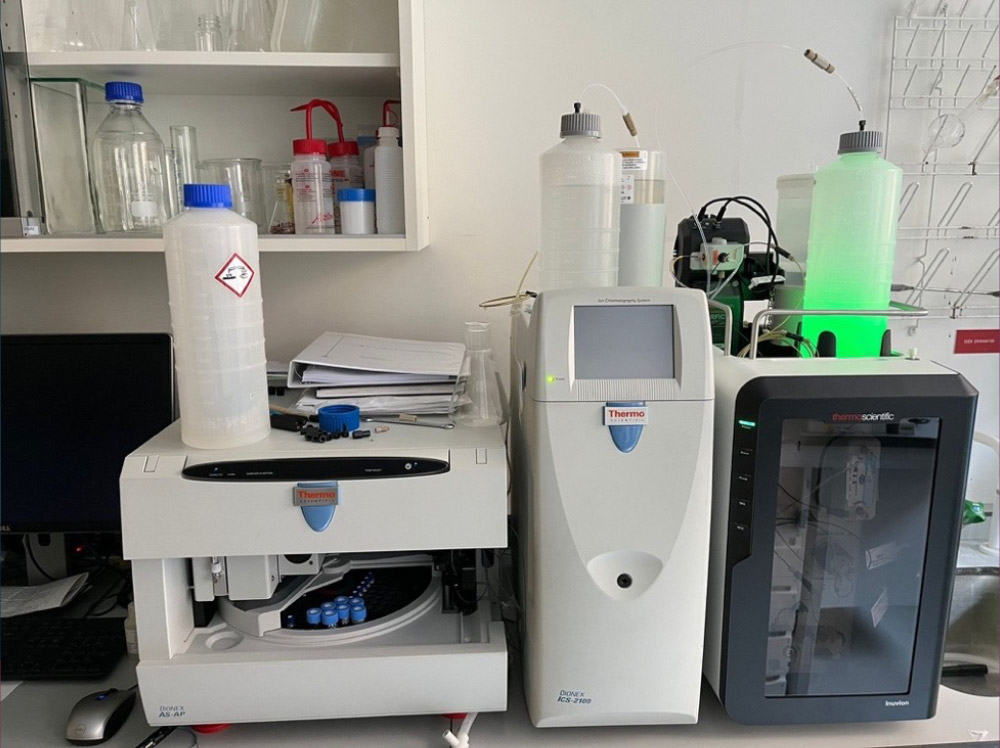 Ion Chromatography PHOTO L. Megens, Cultural Heritage Agency (RCE).
The advantages of this method:
- – ability to distinguish stable glass from unstable glass
- – sampling of surface salts can be performed in situ
- – no glass sample is required
- – ion concentrations on the surface are analysed quantitatively
- – can detect glass instability at an early stage
- – provides guidance for the future design of conservation strategies
Taking a sample
A protocol has been developed that conservators must follow when taking a sample of the salts on the surface of potentially unstable glass. A glass conservator determines where sampling may take place based on observed vulnerabilities in the glass. The location must be representative of the problem and must be carefully documented.
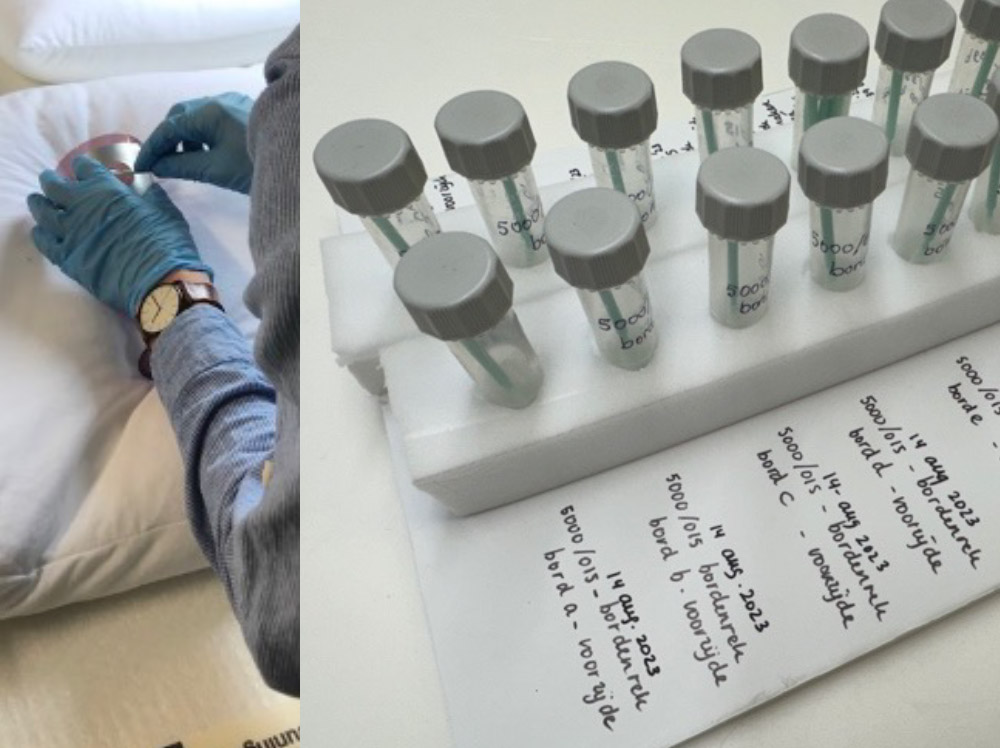 Sampling with a specialist cotton swab. Samples ready for analysis. PHOTO M. Slager
Processing the IC results
Many museums use a collection management system in which information can be retrieved by object number. It is therefore advisable to incorporate information from the IC analysis into the object record. A
form has therefore been developed for this purpose; entering the data and requested information in the relevant fields helps to record the diagnostic aspects of chemical instability.
The outcome of an IC analysis
Together with the findings from the visual examination, a conservator can classify the object into one of the following three categories: likely stable, potentially unstable, and likely unstable. This is an important step in developing a strategy for the responsible storage, handling, conservation or display of glass objects, particularly those that are unstable.
Comparison with other analytical methods
The results of IC analysis should be considered alongside visual findings and the results of any other analyses. This allows the data to be examined in a broader context, providing a more comprehensive understanding of the issue. Other possible analytical methods that may be used include XRF, XRD, SIMS, ICP-MS, SEM, OCT, Terahertz and Raman. Many of these techniques cannot be performed on site and require a glass sample.
Is IC a non-destructive method?
The salts on the surface of glass are, theoretically, part of the glass itself, at least to some extent. Therefore, this method cannot be considered entirely non-destructive. However, the salts on the surface have a negative effect on the condition of the glass (see
atmospheric degradation) and in most cases will need to be removed anyway (see
preventive measures).
documents
sources / further reading
Verhaar, G.,
Glass sickness: Detection and prevention: Investigating unstable glass in museum collections, Thesis, fully internal, University of Amsterdam, 2018
Thesis (pdf)Verhaar G., Bommel van, M.R., Tennent N.H.,
Development and validation of an analytical protocol for the sampling and quantitative analysis of ions on the surface of unstable historic glass in museum collections using ion-exchange chromatography, Journal of Chromatography A, 13 september 2020
ScienceDirect.com
links (dutch)
AVRO - TROS ,
Geheimen van het Museum, Museum Boijmans Van Beuningen, aflevering 4, Toepassing van het IC apparaat, 2025
NPO.nlRijksdienst voor het Cultureel Erfgoed,
General information laboratory research cultureelerfgoed.nlRijksdienst voor het Cultureel Erfgoed,
Application form research RCE cultureelerfgoed.nl